

Every meal
A quick safety checklist
Clean hands and surfaces
Wash your hands, use clean boards and utensils, and keep raw meat away from ready-to-eat food.
Seated and upright
Your child sits upright, facing you, never lying down, walking around or in a moving car.
Safe shapes
Round foods are cut lengthwise, hard foods are cooked soft or grated, and sticky foods are spread thinly.
An adult nearby
Stay with young children the whole time they are eating, even for snacks.
Allergies
How to introduce foods that can cause allergies
The NHS advises introducing the foods that most commonly cause allergies from around 6 months, one at a time and in very small amounts. These include:
cow's milk, eggs, foods containing gluten, peanuts and tree nuts, seeds, soya, fish and shellfish.
- One new allergen at a time
Leave a few days before introducing the next one, so you can tell what caused any reaction.
- Start with a small amount
For example, a little well-cooked egg, or smooth peanut butter thinned with water or milk and spread thinly.
- Choose a good time
Offer new allergens earlier in the day, when your child is well, so you can watch them for the rest of the day.
- Keep it going
If there is no reaction, keep the food as a regular part of your child's diet.
Talk to your GP first if your baby has eczema, an existing food allergy, or a close family history of allergies. They may recommend a specific plan or a referral to an allergy service.
Signs of an allergic reaction
Mild to moderate: an itchy rash or hives, swelling of the lips, face or around the eyes, tummy pain, vomiting or diarrhoea.
Severe (anaphylaxis) is an emergency: difficulty breathing, wheezing or noisy breathing, swelling of the tongue or throat, a hoarse voice, becoming pale, floppy or unresponsive. Call 999 (or your local emergency number) straight away, and use an adrenaline auto-injector if your child has been prescribed one.
Choking hazards
Foods that are most likely to cause choking
Young children's airways are small, and they are still learning to chew. According to the CDC and the NHS, the riskiest foods share certain shapes and textures:
Small and round
Whole grapes, cherry tomatoes, blueberries, olives and large berries.
Hard
Whole nuts, raw carrot or apple, hard sweets and popcorn.
Plug-shaped
Sausage or hot dog rounds and chunks of cheese.
Sticky or chewy
Thick blobs of nut butter, marshmallows, chewing gum and tough meat.
Whole nuts should not be given to children under 5. Gagging, which is noisy with coughing, is common while children learn to eat. Choking is different: it is often silent, and the child cannot breathe, cry or cough.
Safe preparation
How to cut the foods that choke most often
The simple rule: make round foods flat, turn coin shapes into strips, and make hard foods soft.
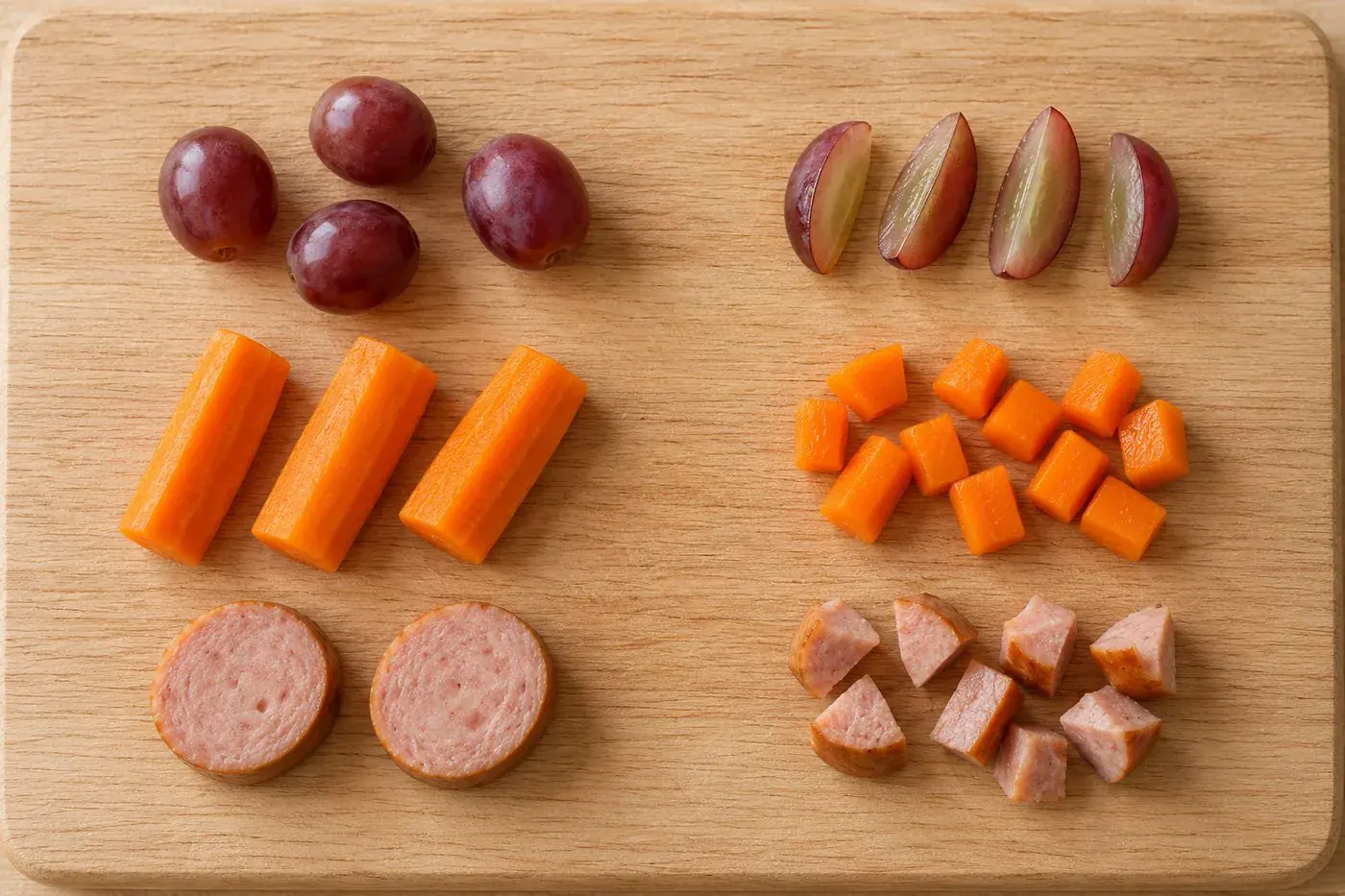
| Food | Safer way to serve it | Avoid |
|---|---|---|
| Grapes and cherry tomatoes | Cut into quarters lengthwise | Whole, or halved across the middle |
| Sausages and hot dogs | Cut lengthwise into thin strips | Round slices |
| Apple, carrot and other hard veg | Grate, or cook until soft | Raw chunks or sticks for young children |
| Cheese | Grate, or cut into thin strips | Cubes |
| Nut butter | Spread thinly, or thin with water or milk | Spoonfuls or thick blobs |
| Nuts and seeds | Finely ground, or as a smooth butter | Whole or in pieces, under 5 years |
| Blueberries | Squash flat or cut in half | Whole, for young babies |
For textures at each age, see first bites to family food.
Kitchen hygiene
Good habits before you heat a pan
- Wash your hands before preparing food and after touching raw meat, eggs or unwashed vegetables.
- Use separate chopping boards for raw meat, or wash them well between uses.
- Cook chicken, other meat and eggs thoroughly, until they are steaming hot and there is no pink meat.
- Cool leftovers quickly, keep them in the fridge, and reheat them only once until steaming hot.
- Test the temperature of food before giving it to your child.
If your child is choking
Follow the NHS guidance on choking. In brief:
- If they can cough, encourage them to keep coughing and stay with them.
- If they cannot cough, cry or breathe, give up to 5 back blows. For a baby under 1, follow with up to 5 chest thrusts. For a child over 1, follow with up to 5 abdominal thrusts.
- Call 999 (or your local emergency number) if the blockage does not clear, and keep going until help arrives.
- Never put your fingers into a child's mouth to search for food blindly.
A baby and child first aid course is the best way to feel ready. Your health visitor, local council or first aid charities can point you to one.
FAQ
Common questions
Should I delay giving allergy foods to be safe?
No. Current NHS advice is not to delay introducing common allergens beyond around 6 months, as there is no benefit in waiting. Introduce them one at a time, and speak to your GP first if your baby has eczema or a known allergy.
When can my child have whole nuts?
Not before 5 years old, because of the choking risk. Ground nuts and smooth nut butters can be introduced from around 6 months, unless your child has a known allergy.
Is gagging dangerous?
Gagging is a normal reflex that helps move food forward, and is common as babies learn to eat. Stay calm and let your child work it out. Choking is silent and needs immediate help.
Can my child eat in the car or while walking?
It is safer not to. Children should sit upright and be supervised while eating, so an adult can help straight away if something goes wrong.
Sources
Where this guide comes from
- NHS: Food allergies in babies and young children
- NHS: Foods to avoid giving babies and young children
- NHS: How to stop a child from choking
- CDC: Choking hazards
- American Academy of Pediatrics: Choking prevention
This guide is general information, not medical advice, and does not replace first aid training. In an emergency, call your local emergency number.
The more you bundle, the more you save.
Add ebooks to your cart and the discount applies automatically at checkout - no code to remember, mix and match any titles.
Pick any two ebooks and the discount is applied automatically in your cart.
Build a fuller shelf and the discount steps up - still no code needed.
Add a fourth ebook to your cart and one of them is on us.
Bundle pricing is calculated from the ebooks in your cart at checkout - the discount or free ebook is applied automatically once your cart qualifies.