“We do something different every night.”
Start by building a short sequence the family can repeat: the same order, a similar bedtime window, and a clear ending.

Search ebooks, guides, stories and parenting topics.
Parenting topic · Sleep & routines
Bedtime does not need a perfect chart or a two-hour ritual. Most families need something simpler: enough time for sleep, a predictable wind-down, clear limits, and a plan for the nights when the routine falls apart.

If bedtime is happening now
Tonight is not the moment to redesign the whole family routine. Reduce decisions and move toward the same familiar ending.
End stimulating play and make the next step obvious: bathroom, pyjamas, book, bed-or your family’s equivalent.
A routine works because it is repeatable. Use the smallest version you can realistically do again tomorrow.
One final book, hug, phrase or goodnight cue is easier to repeat than an open-ended negotiation.
Start with the problem
Different problems need different solutions. A bedtime routine, a child who keeps leaving the room and a child who is snoring loudly are not the same issue.
Start by building a short sequence the family can repeat: the same order, a similar bedtime window, and a clear ending.
Look at delay tactics, unclear endpoints, inconsistent limits, separation worries and whether the routine keeps expanding.
Start by separating an occasional difficult night from a persistent sleep problem, illness, discomfort, breathing issue or anxiety that may need individualized advice.
Morning, after-school and bedtime routines work better when fewer decisions are left to the busiest moment of the day.
Sleep need is bigger than bedtime
A bedtime routine can help a child wind down, but it cannot compensate for a schedule that does not leave enough opportunity for sleep.
These are consensus ranges for healthy children. Individual sleep needs vary, and naps count for the younger age groups.
| Age | Recommended sleep per 24 hours |
|---|---|
| 1-2 years | 11-14 hours, including naps |
| 3-5 years | 10-13 hours, including naps |
| 6-12 years | 9-12 hours |
Source: American Academy of Sleep Medicine consensus recommendations. This table is educational and is not an individualized sleep prescription.
A Twinkens memory aid
A simple way to remember what makes an evening routine easier to repeat.
C.L.O.S.E. is a Twinkens editorial framework. It is not a clinical sleep protocol or treatment program.
Use a bedtime range the household can usually keep rather than chasing the exact minute every night.
Move away from stimulating play, bright screens and high-energy activities as bedtime approaches.
Bath or wash-up, teeth, pyjamas, book, bed-or another short sequence your family can repeat.
One clear final step keeps the routine from growing into another book, another drink and another negotiation.
Use the same short goodnight cue and leave the routine as predictably as you started it.
More useful
Often makes bedtime harder
Bedtime battles
Resistance is easier to change when you know what part of the evening keeps reopening the loop.

If the number of books, drinks or trips changes every night, the child has no reliable signal that bedtime is actually finished.
A short warning and a predictable next step can make the move from play to bedtime less abrupt.
A complicated routine is hard for parents to repeat and gives more opportunities for delay.
Save non-urgent arguments, chores and behavior debriefs for another part of the day when possible.
If bedtime is consistently difficult, look at total sleep, naps, wake time and daytime activity before adding more bedtime rules.
Pain, illness, anxiety, breathing problems and other sleep concerns deserve individualized attention rather than another routine trick.
Screens & wind-down
The American Academy of Pediatrics recommends keeping screens away from the bedtime period and out of bedrooms when possible. The practical goal is not to shame screen use-it is to protect the routine from autoplay, alerts and content that keeps the evening going.
Decide the last episode, game or activity before it begins rather than negotiating after the child is absorbed.
“When this ends, we brush teeth and choose one book” is clearer than simply removing the screen with no transition.
Removing alerts and late-night checking can make the sleeping space easier to protect.
A family wind-down rule is easier to understand when adults are not scrolling beside the bed.
Routines beyond bedtime
A routine is not a minute-by-minute schedule. It is a small number of events that happen in a familiar order often enough to reduce decision-making.

Clothes, breakfast, bag and leaving time are easier when the sequence is visible and repeated.
A consistent place for shoes, bags, snack and decompression can reduce the next rush.
Choose what actually needs to happen tonight. Do not turn bedtime into the place where every unfinished task gets added.
The same short ending helps the routine feel finished even when the rest of the day was messy.
When a routine is not enough
Talk with your child’s pediatrician or another qualified health professional if sleep problems are persistent, severe, affecting daytime functioning, or accompanied by symptoms that concern you.
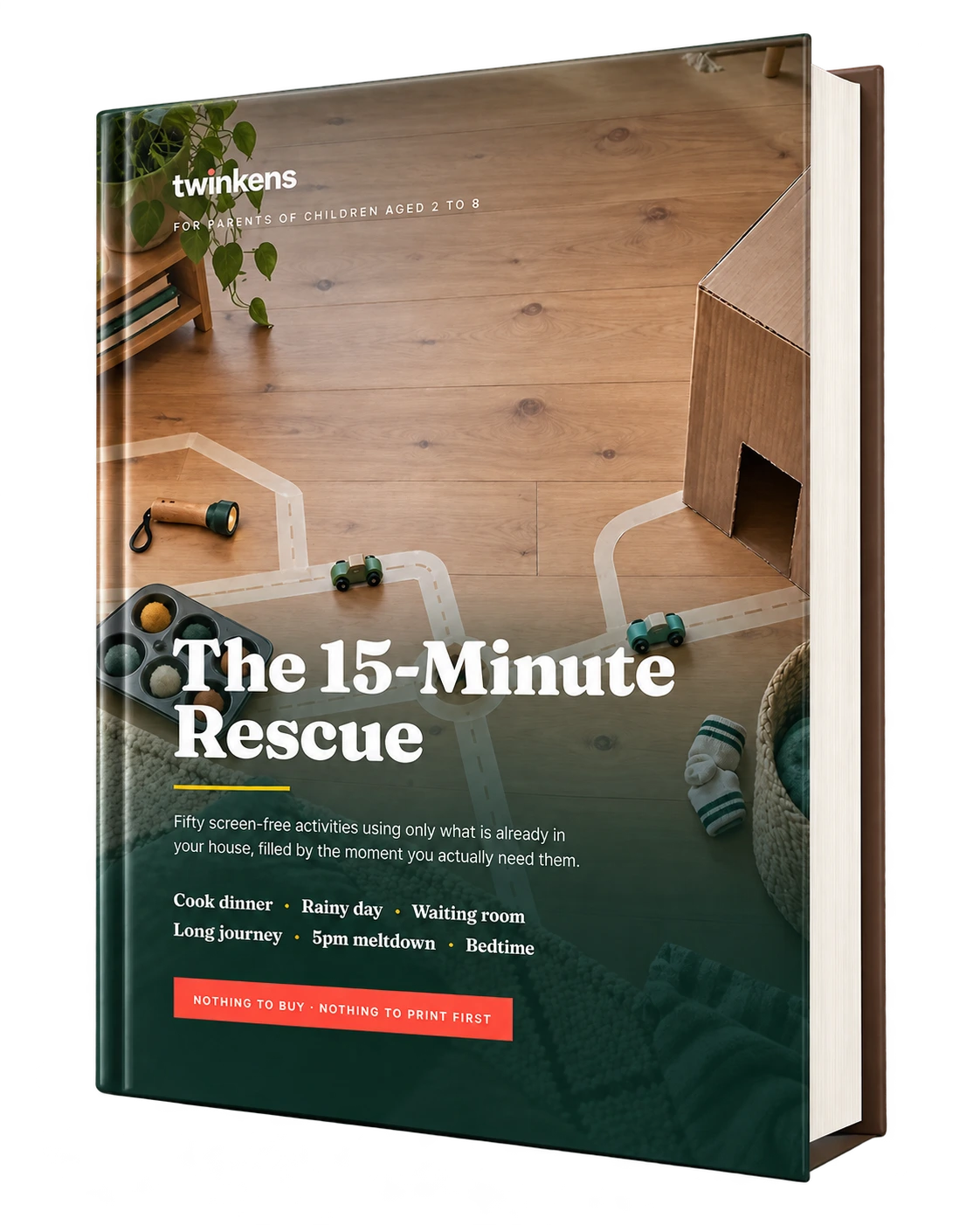
The book includes 50 screen-free activities for children ages 2-8, organized around real family moments-including a wind-down-before-bed section with quieter, connection-based ideas.
Sources & editorial standard
Sleep is a health topic. Twinkens should source age-based sleep recommendations and health claims from recognized clinical or public-health organizations, and clearly separate general routines from medical advice.
Related topics
Start with the part of the evening that keeps breaking down, choose one change and make tomorrow night simpler-not more complicated.
Add ebooks to your cart and the discount applies automatically at checkout - no code to remember, mix and match any titles.
Pick any two ebooks and the discount is applied automatically in your cart.
Build a fuller shelf and the discount steps up - still no code needed.
Add a fourth ebook to your cart and one of them is on us.
Bundle pricing is calculated from the ebooks in your cart at checkout - the discount or free ebook is applied automatically once your cart qualifies.
Download the Twinkens Android app for warm, screen-free stories children will love.
Download on Google Play