“I feel emotionally drained by parenting.”
Learn what researchers mean by parental burnout, what may increase the load and when exhaustion needs professional mental-health support.

Search ebooks, guides, stories and parenting topics.
Parenting topic · Parent wellbeing
Parenting can be meaningful and still be exhausting. This hub is for the part that often gets pushed to the bottom of the list: your capacity, your mental load, your time and the support you have around you.

If you are overloaded today
Start by reducing one demand, getting one task out of your head, and asking for one concrete form of help if it is available.
Choose something that can be delayed, simplified, skipped or done to a lower standard today.
Write down the next few tasks so your brain is not also responsible for continuously remembering them.
“Can you handle bath tonight?” is easier to answer than “I need more support.”
Start with the pressure point
Stress, burnout, mental load and lack of time overlap, but they are not identical problems. Start with the one that is costing you the most capacity.
Learn what researchers mean by parental burnout, what may increase the load and when exhaustion needs professional mental-health support.
Externalize recurring tasks, decide who owns them and reduce the invisible work of remembering, tracking and reminding.
Reduce recurring decisions, batch what can be batched and protect buffers instead of trying to optimize every minute.
Start with small, realistic recovery opportunities and support-not a fantasy version of self-care that requires more time, money and planning.
Stress is not the same as burnout
Stress is a normal response to demanding situations. Long-term stress can affect sleep, concentration, mood, appetite and physical health, and it is worth taking seriously when it starts to impair daily life.
Parental burnout is a research concept describing more persistent parenting-related exhaustion, emotional distancing from one’s children and a loss of fulfillment in the parenting role. It is distinct from ordinary bad days and can overlap with other mental-health problems that need individual assessment.
This page can help you notice the load and identify next steps. It cannot distinguish burnout from depression, anxiety, trauma, sleep deprivation, a medical condition or another cause of persistent exhaustion.
Think in demands and resources
Research on parental burnout often describes a mismatch between demands and the resources available to meet them. That means the practical question is two-sided: what can be reduced, and what support can be added?

A Twinkens load-reduction aid
A simple four-part check for the days when “do more self-care” is the last thing you need to hear.
L.E.S.S. is a Twinkens editorial framework for organizing general wellbeing ideas. It is not mental-health treatment or a validated burnout intervention.
Write down what you are carrying: tasks, decisions, appointments, emotional work, reminders and unfinished loops.
Remove, postpone or lower the standard on one demand that does not need to stay exactly as it is.
Hand off ownership, not just the final task. If someone owns laundry, they also own noticing when it needs doing.
Choose a realistic pause: ten quiet minutes, a walk, an earlier bedtime, time with a friend or another form of rest that is actually available to you.
Mental load
A family system is not only a shared calendar. It also answers who notices, who decides, who follows up and who is responsible when plans change.
Use one family calendar, one place for school information and one list for recurring household tasks instead of storing them in one person’s memory.
A task is genuinely shared when another adult owns the remembering, planning and follow-through-not only the final five minutes of execution.
Some tasks are essential. Some can wait. Some can disappear. Treating all three categories as urgent creates permanent overload.
Repeat meals, recurring shopping lists, set laundry days and standard routines reduce the number of decisions that need to be made from scratch.
A schedule packed to the minute has no room for a late bus, a sick child or a difficult bedtime. Margin is part of the plan.
When the same failure repeats every week, change the setup before deciding someone simply needs to “try harder.”
A weekly family reset
This is not about running the home like a company. It is about moving predictable decisions out of the most stressful moments of the week.
What appointments, school events and fixed commitments are coming?
Which meals need planning, and which nights need a backup option?
Who owns each recurring task this week-including remembering it?
Which part of the week is likely to be hardest, and what can be simplified before it arrives?
Self-care without the performance
The APA notes that small, manageable breaks can be more realistic for overloaded parents than waiting for a full day or weekend away.

Tea without multitasking, a short walk, sitting outside, breathing, stretching or another quiet activity can be more realistic than adding a complicated wellness routine.
Stress management is harder when the body is chronically under-rested, under-fed or never gets a chance to move.
A trusted friend, partner, family member, support group or professional can reduce isolation and help turn vague distress into specific support.
Ask for support concretely
Specific requests are easier for another person to act on. Support can be emotional, logistical, financial, childcare-related or professional.
“Can you watch the kids Saturday from 10 to 12?”
“Can you own dinner on Tuesdays, including planning and shopping?”
“Can I call you tonight? I do not need solutions; I need ten minutes to talk.”
“My stress is affecting how I function. I want help figuring out what is going on.”
When professional support makes sense
Consider talking with a doctor, therapist, psychologist or another qualified mental-health professional if stress or exhaustion is persistent, worsening or interfering with your ability to function safely at home, work or in relationships.
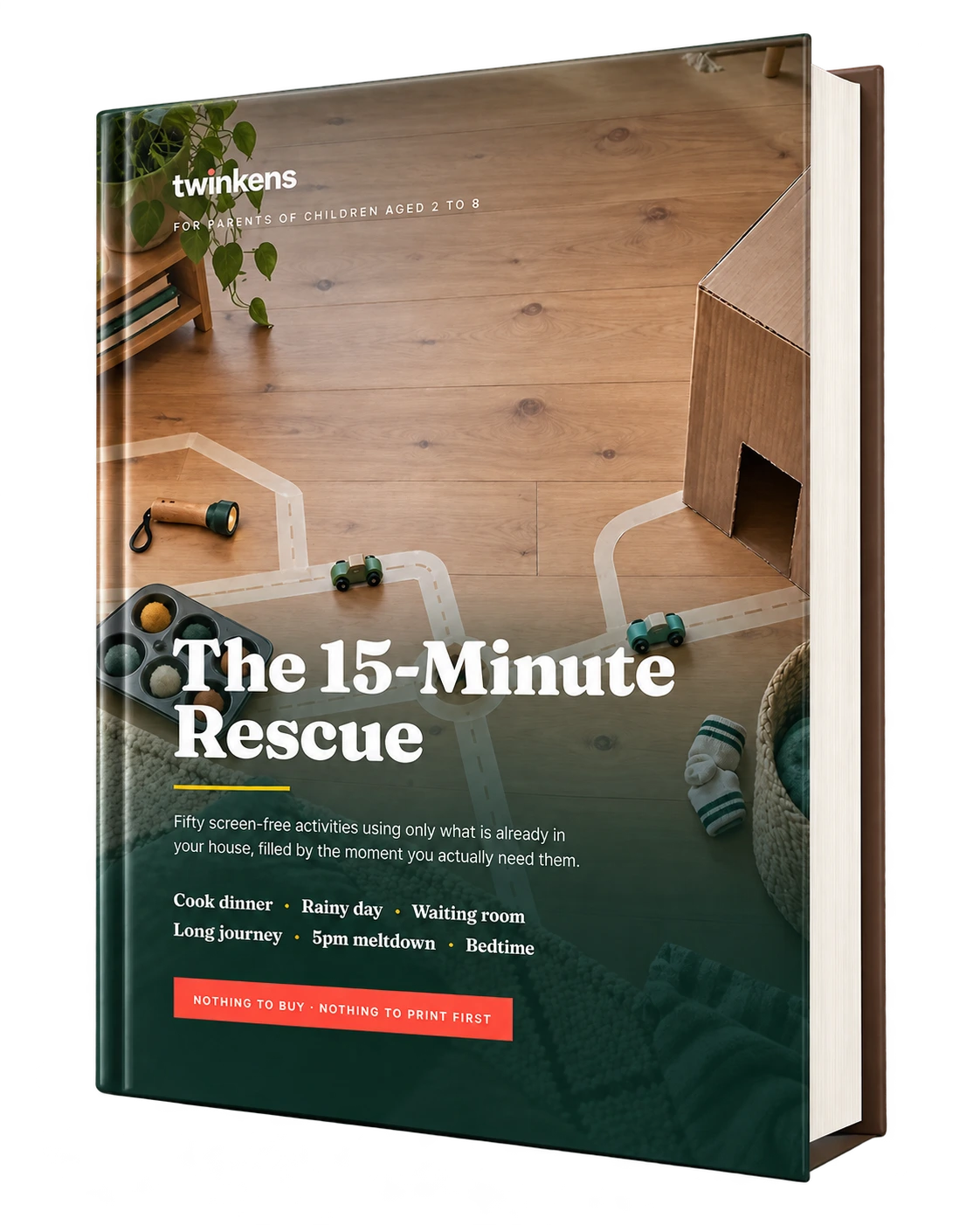
If one of your hardest windows is “I need fifteen minutes to cook, finish a call or reset while my child is occupied,” this book gives you ready-to-use screen-free activity ideas. It can remove one small decision; it is not a burnout or mental-health intervention.
Sources & editorial standard
Stress, burnout and mental health affect health and safety. Twinkens should source factual claims carefully, avoid online diagnosis and distinguish practical family organization from psychological treatment.
Related topics
Start by making the load visible, remove one demand, share one responsibility and get professional support when the problem is bigger than a family system can solve.
Add ebooks to your cart and the discount applies automatically at checkout - no code to remember, mix and match any titles.
Pick any two ebooks and the discount is applied automatically in your cart.
Build a fuller shelf and the discount steps up - still no code needed.
Add a fourth ebook to your cart and one of them is on us.
Bundle pricing is calculated from the ebooks in your cart at checkout - the discount or free ebook is applied automatically once your cart qualifies.
Download the Twinkens Android app for warm, screen-free stories children will love.
Download on Google Play