“Everything is a competition.”
Attention, turns, achievements and who got what first can become a running scorecard between siblings.

Search ebooks, guides, stories and parenting topics.
Parenting topic · Sibling relationships
Siblings can love each other and still fight over a toy five minutes later. The goal is not a conflict-free home. It is to know when to step in, when to give them space, and how to help them learn what repair looks like.
If they are fighting now
You do not need a courtroom investigation in the middle of a fight. First decide whether the children can keep working on it safely.
Separate children if there is hitting, biting, throwing, intimidation, or anyone cannot stay safe.
Give each child enough space to calm down. A solution is easier after the argument is no longer escalating.
Once everyone can listen, help them name the problem and decide what needs to happen next.
Start with the pattern
Choose the closest problem. These paths help you reach the right guide; they are not labels for either child.
Attention, turns, achievements and who got what first can become a running scorecard between siblings.
Start with the difference between a disagreement they can work through and a fight that needs adult intervention.
Jealousy can grow around attention, privileges, possessions or a new sibling. The answer is rarely “make everything identical.”
Some conflicts need a clearer household rule around turns, private belongings and personal space-not another lecture about sharing.
Understand sibling conflict
Brothers and sisters will disagree. The American Academy of Pediatrics notes that what children fight about changes with age, and that learning to disagree respectfully is part of developing communication and coping skills.
That does not mean parents should ignore every fight. Younger children usually need more help, and adults should step in when there is concern about a child’s physical or emotional wellbeing.
Ask instead:
You can often step back when
Step in when
A Twinkens memory aid
A four-step way to remember your job when a sibling fight needs adult help.
C.A.L.M. is a Twinkens editorial framework for organizing general parenting guidance. It is not a clinical protocol or validated treatment.
Stop harm and create physical space before asking anyone to explain what happened.
You do not need to decide the entire case immediately. Listen without turning the conversation into a trial.
Give each child a short turn to say what they wanted, what happened and what they need now.
Return the toy, rebuild what was knocked down, agree on turns, create space, or practice what to say next time.
Reduce repeated friction
You cannot remove every disagreement, but you can make the predictable ones easier to navigate.
Simple household rules such as “no hitting,” “ask before entering a bedroom” or “private belongings stay private” are easier to enforce than vague instructions to “be nice.”
Individual attention does not need to be elaborate. Small recurring moments with each child can matter because siblings often compete for access to the same parent.
Choose some games, chores and family tasks where the children succeed together instead of keeping score against one another.
Children may need separate storage, special belongings that are not automatically shared, and permission to take a break from each other.
Describe effort, humor, kindness or interests without turning praise into a comparison: “You worked hard on that,” not “Why can’t your brother do that too?”
If fights always happen before dinner, during the same game or around one toy, change the setup instead of waiting for the same argument again.
Fairness without scorekeeping
Children differ in age, maturity, interests and needs. Trying to make every minute, possession and privilege exactly the same can create a new competition: who got more?
Both children receive the exact same response because the goal is numerical equality.
Each child receives a clear, explainable response that fits the situation, age and household rule.
After the fight
An apology can be meaningful when the child understands what they are repairing. It is less useful as a sentence forced out while everyone is still angry.
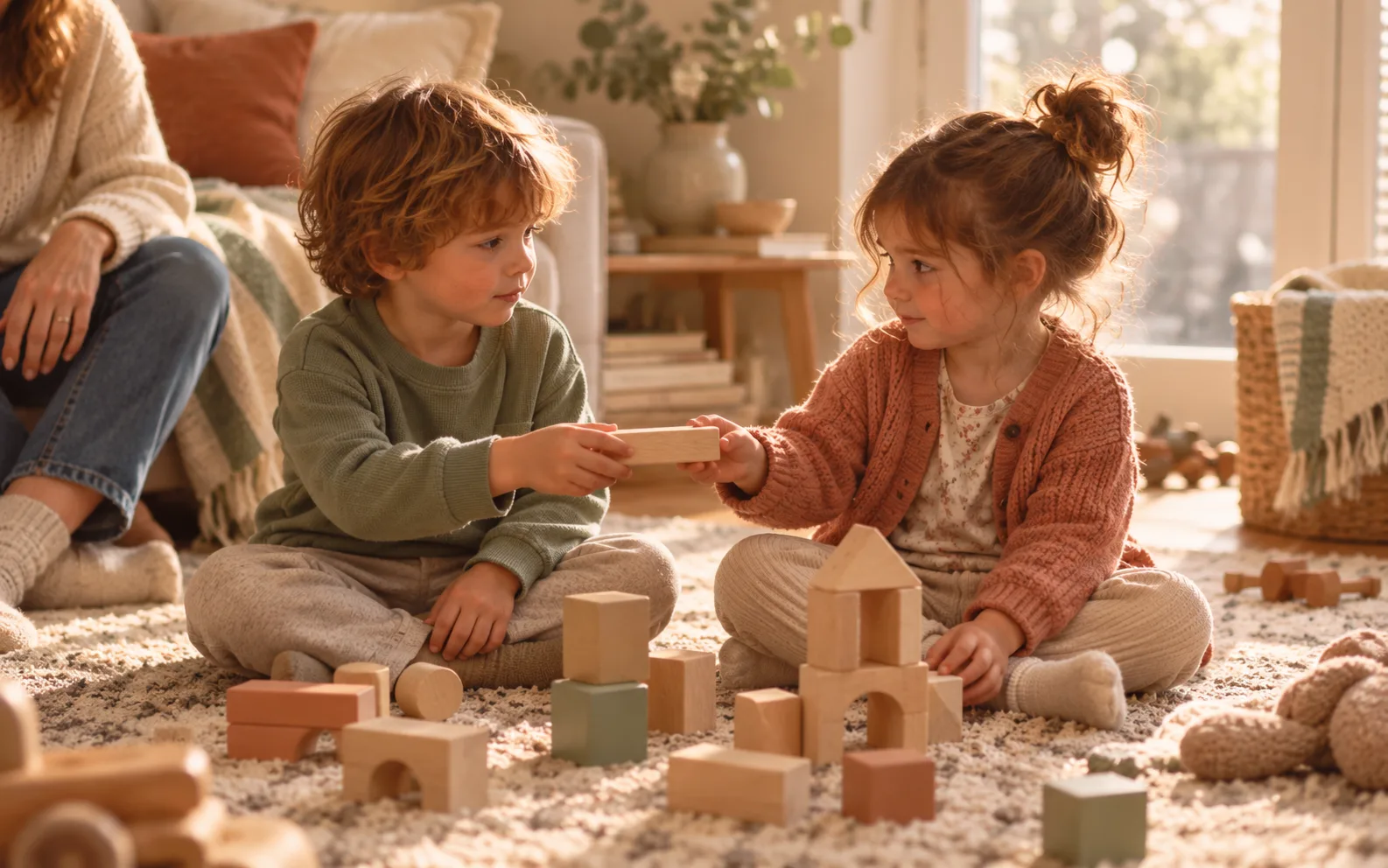
“The tower got knocked down.” “Your brother got hurt.” “She was using that toy when you took it.” Keep it factual.
Return an item, rebuild, get an ice pack, give space, or agree on the next turn. Repair should connect to what actually happened.
Try one sentence or action for next time: “Can I have it when you’re done?” “Stop.” “I need space.” “Can you help us?”
When sibling conflict needs more attention
Sibling conflict is common, but repeated or severe aggression deserves attention-especially when one child is consistently frightened, injured, humiliated, threatened or unable to get away from the other.
Need a deeper Twinkens resource?
When the free guidance is not enough, the complete 164-page guide adds 26 chapters, quick-reference cards, practical tools and a thirty-day plan for building calmer conflict skills.
Sources & editorial standard
Sibling advice can touch behavior, emotional wellbeing and family relationships. Twinkens should distinguish general parenting guidance from professional assessment and support factual claims with recognized sources.
Related topics
You need a safer, clearer way to handle conflict-and enough room for the relationship to recover afterward.
Add ebooks to your cart and the discount applies automatically at checkout - no code to remember, mix and match any titles.
Pick any two ebooks and the discount is applied automatically in your cart.
Build a fuller shelf and the discount steps up - still no code needed.
Add a fourth ebook to your cart and one of them is on us.
Bundle pricing is calculated from the ebooks in your cart at checkout - the discount or free ebook is applied automatically once your cart qualifies.